
A Wave to Remember – But What Has Changed?
The 2026 midterm elections are now in the rearview mirror. As a sports fan, I’m happy to watch a game again without the nonstop attack ads. As an investor, there are a few takeaways worth considering – but just as important is the question: has anything really changed?
Results
The results suggest voters were looking for a change in direction from the administration’s agenda. Many candidates endorsed by President Trump were unsuccessful, and several Republican strongholds, including Texas and South Carolina, elected Democratic candidates in races the party had not won in decades.
Democrats now hold majorities in both the House and the Senate. However, those majorities are not large enough to override a presidential veto or overcome a Senate filibuster, so meaningful legislation will still require bipartisan agreement. With President Trump in the White House and a Congress far less inclined to advance his agenda, the most likely outcome through 2028 is a high degree of conflict and legislative gridlock.
What Might Change
A shift of this size is worth examining for its potential beneficiaries and its potential headwinds. Two themes stand out early:
- Affordability takes center stage. Concerns about the cost of living – from gas prices to persistent inflation – were a driving force behind the “Blue Wave.” Voters clearly want action, but with divided government, a bipartisan solution may be difficult to achieve. For investors, that keeps the spotlight on inflation, interest rates, and energy prices, and on the consumer-facing companies most sensitive to all three. Expect affordability to remain a political lever through 2028, even if little legislation actually passes.
- AI infrastructure faces a headwind. Voters have increasingly pushed back on data center development in their own communities. While AI adoption continues to grow, the infrastructure behind it is energy intensive, which can raise utility costs for households, and many voters have questioned whether it delivers lasting local job growth. Democrats have tended to be more cautious on AI deployment, while Republicans – especially President Trump – have generally been supportive. Following these results, we could see greater scrutiny of the costs and regulation of AI infrastructure, much of it at the state and local level through zoning and utility rate decisions. Utilities, power providers, and data center developers are the areas to watch.
Keeping Perspective
- Midterm history. The party in power has historically lost seats in midterm elections. The magnitude was larger this time, and flipping seats in states like Texas and South Carolina was surprising, but a diminished majority for the incumbent party is consistent with history.
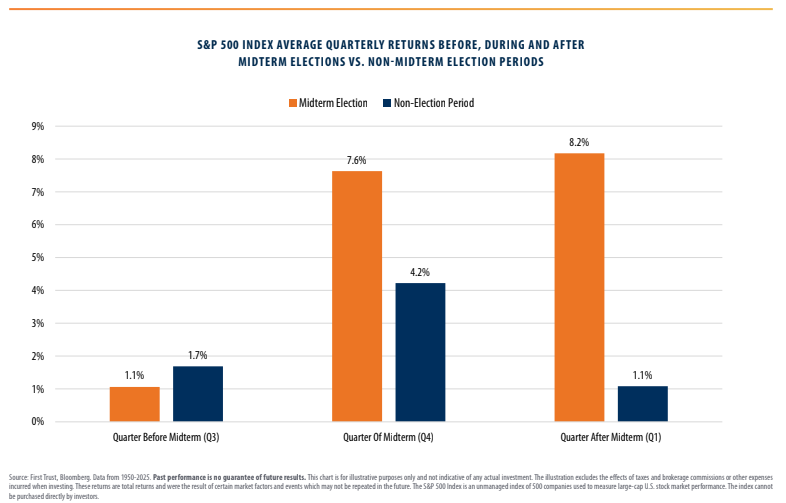
- Fear tends to fade. Every election brings some version of “you think it’s bad now, wait ’til the other side is in charge!” It makes a good talking point, but there is little historical evidence that midterm elections cause market collapses, regardless of which party gains control. Using First Trust and Bloomberg data going back to 1950, the chart below shows that the S&P 500 has, on average, lagged in the quarter before a midterm and then outperformed meaningfully in the quarter of the election and the quarter after – a pattern often attributed to election uncertainty giving way to clarity. Many market observers also note that markets have historically handled divided government well, since gridlock tends to limit sweeping policy surprises.
What Do We Do Now?
After every midterm, advisors are often asked: what do we do now?
Our philosophy is simple: portfolio decisions should be driven by your personal circumstances, not by politics.
As advisors, it is our responsibility to understand where political change may affect stocks, bonds, commodities, and other assets. It is just as important to recognize that your goals, risk tolerance, and time horizon should take priority over any election outcome. Three questions help keep that in focus:
- Did your goals change as a result of this election?
- Did your time horizon for reaching those goals change?
- Is your portfolio still aligned with your goals and your time horizon?
If the answer to the first two questions is no, the third is usually a matter of routine rebalancing rather than a reaction to the headlines. These questions – not election results – drive your investment allocation and the investments we believe are best suited to achieving your objectives.
This content, which contains security-related opinions and/or information, is provided for informational purposes only and should not be relied upon in any manner as professional advice, or an endorsement of any practices, products or services. There can be no guarantees or assurances that the views expressed here will be applicable for any particular facts or circumstances, and should not be relied upon in any manner. You should consult your own advisers as to legal, business, tax, and other related matters concerning any investment.
The commentary in this “post” (including any related blog, podcasts, videos, and social media) reflects the personal opinions, viewpoints, and analyses of IndiWealth employees providing such comments, and should not be regarded the views of IndiWealth LLC. or its respective affiliates or as a description of advisory services provided by IndiWealth or performance returns of any IndiWealth client.
References to any securities or digital assets, or performance data, are for illustrative purposes only and do not constitute an investment recommendation or offer to provide investment advisory services. Charts and graphs provided within are for informational purposes solely and should not be relied upon when making any investment decision. Past performance is not indicative of future results. The content speaks only as of the date indicated. Any projections, estimates, forecasts, targets, prospects, and/or opinions expressed in these materials are subject to change without notice and may differ or be contrary to opinions expressed by others.
Investments in securities involve the risk of loss.