
Cool People, Good Work: National Indigenous Women’s Resource Center
In this installment of Cool People, Good Work, we’re highlighting the National Indigenous Women’s Resource Center (NIWRC) — a Native-led nonprofit providing national leadership to end violence against Native women, children, and communities. NIWRC supports grassroots advocates, builds culturally grounded tools and training, and advances policy that addresses the issues pertaining to Missing and Murdered Indigenous Women and Relatives (MMIWR).
Who they serve
NIWRC advocates for American Indian, Alaska Native, and Native Hawaiian women — and the Tribal programs, coalitions, and community leaders who stand with them. Their audience also includes anyone looking to learn and act: from service providers and policymakers to allies who want to help make a difference.
How they help
- Training & technical assistance: Practical guidance for Tribal programs responding to intimate partner and sexual violence, stalking, trafficking, and the crisis of Missing and Murdered Indigenous Women and Relatives (MMIWR).
- Awareness & organizing: NIWRC helps coordinate the National Day of Awareness for MMIW on May 5 and the broader MMIWR Week of Action, offering messaging kits and community actions that center families and survivors.
- Resources & storytelling: Restoration magazine and NIWRC’s resource library share survivor-led solutions and policy updates to inform, equip, and inspire action.
- Crisis support, 24/7: NIWRC helped launch StrongHearts Native Helpline (phone, text, chat) for confidential, culturally grounded advocacy: 1-844-7NATIVE (762-8483).
Why it’s needed
The data are grim — and not widely known outside Native communities. A landmark National Institute of Justice (NIJ) study from 2016 found:
- More than 4 in 5 AI/AN women (84.3%) have experienced violence in their lifetime, including 56.1% sexual violence and 55.5% physical violence by an intimate partner.
- AI/AN women were 1.2× as likely as non-Hispanic White women to have experienced violence in their lifetime.
- This is not a “Native-Only” problem – 97% of AI/AN female victims had at least one non-Native perpetrator in their lifetime.
- Homicide is a leading cause of death for Native women in key age groups: in 2019 it ranked 3rd for AI/AN girls 15–19 and women 20–24, and 4th for women 25–34.
- On some reservations, Native women face murder rates more than 10× the national average.
Awareness without sensationalism
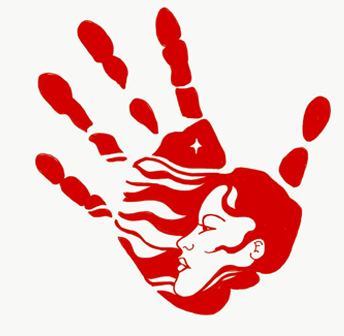
A central theme in NIWRC’s approach is respectful awareness. Rather than leaning on graphic imagery or sensational headlines, NIWRC centers on families and survivors—their names, stories, and their dignity. Symbols like Wear Red on the May 5 National Day of Awareness and the red handprint honor lives and call attention to the crisis and the victims without exploiting their trauma.
“Talk about the victim, tell their story, keep them alive in that aspect. They’re only gone when we stop talking about them.” – Capt. Paul Etnire (Hopi), Arizona Department of Public Safety
Policy wins (and why they matter)
Advocacy from NIWRC and grassroots partners has helped drive concrete federal action:
- Not Invisible Act (2019). Aims to improve coordination among federal agencies and law enforcement, elevate survivor and family voices, and create structures (like advisory bodies and joint efforts) to address violent crime in Indian Country and against AI/AN people.
- Savanna’s Act (2020). Named for Savanna LaFontaine-Greywind (Spirit Lake Nation), this law focuses on better data, protocols, and information sharing for missing and murdered cases—pushing for clearer guidelines, training, and accountability so families aren’t left to navigate a complex system alone.
Resources
To be clear, we’re not policy or advocacy experts. Our goal with Cool People, Good Work is to spotlight people and organizations lifting their communities and tackling hard problems head-on — and NIWRC absolutely fits that bill. They’re one of many doing vital work to end violence against Native women.
Below are a few places to learn more, get involved, or seek help.
- Learning Resources:
- Get Help:
If you’re concerned someone may monitor your devices, consider using a safe device and clearing your browsing history.
Photo Credit: From MMIWG2S, by Brianna Wentz, 2021, Teen Talk (https://teentalk.ca/2021/09/28/mmiwg2s-2/).
This content, which contains security-related opinions and/or information, is provided for informational purposes only and should not be relied upon in any manner as professional advice, or an endorsement of any practices, products or services. There can be no guarantees or assurances that the views expressed here will be applicable for any particular facts or circumstances, and should not be relied upon in any manner. You should consult your own advisers as to legal, business, tax, and other related matters concerning any investment.
The commentary in this “post” (including any related blog, podcasts, videos, and social media) reflects the personal opinions, viewpoints, and analyses of IndiWealth employees providing such comments, and should not be regarded the views of IndiWealth LLC. or its respective affiliates or as a description of advisory services provided by IndiWealth or performance returns of any IndiWealth client.
References to any securities or digital assets, or performance data, are for illustrative purposes only and do not constitute an investment recommendation or offer to provide investment advisory services. Charts and graphs provided within are for informational purposes solely and should not be relied upon when making any investment decision. Past performance is not indicative of future results. The content speaks only as of the date indicated. Any projections, estimates, forecasts, targets, prospects, and/or opinions expressed in these materials are subject to change without notice and may differ or be contrary to opinions expressed by others.
Investments in securities involve the risk of loss.