

IndiView Chart of the Week: Investing Reserves
Earlier this month, I attended an online webinar from Propel Nonprofits on the topic of operating reserves. For those unfamiliar, Propel offers strategic consulting and accounting/finance services for nonprofit organizations.
Much of their presentation focused on why reserves matter and how to build them. That framework is essential: operating reserves provide flexibility and long-term sustainability, while also serving as a “rainy day fund” — whether that’s a leaky roof, unexpected staffing needs, or broader economic disruption. If you’d like to dig into Propel’s full discussion, I’ve included the link to their excellent webinar at the end.
Where IndiWealth Fits In: Investing Reserves
Our expertise begins once reserves are established. Too often, nonprofits assume these funds must remain in a bank account to ensure safety and accessibility. That’s partly true, but also incomplete:
Accurate:
- Reserves should be liquid and accessible.
- Reserves should be managed with an appropriate level of safety.
Incomplete:
- Reserves do not have to remain in a bank account.
- Investment accounts can be linked directly to operating accounts, with funds transferable in just a few days.
- Reserves can be invested prudently, generating returns that outpace traditional savings while staying aligned with liquidity needs.
A Time-Based Investment Strategy
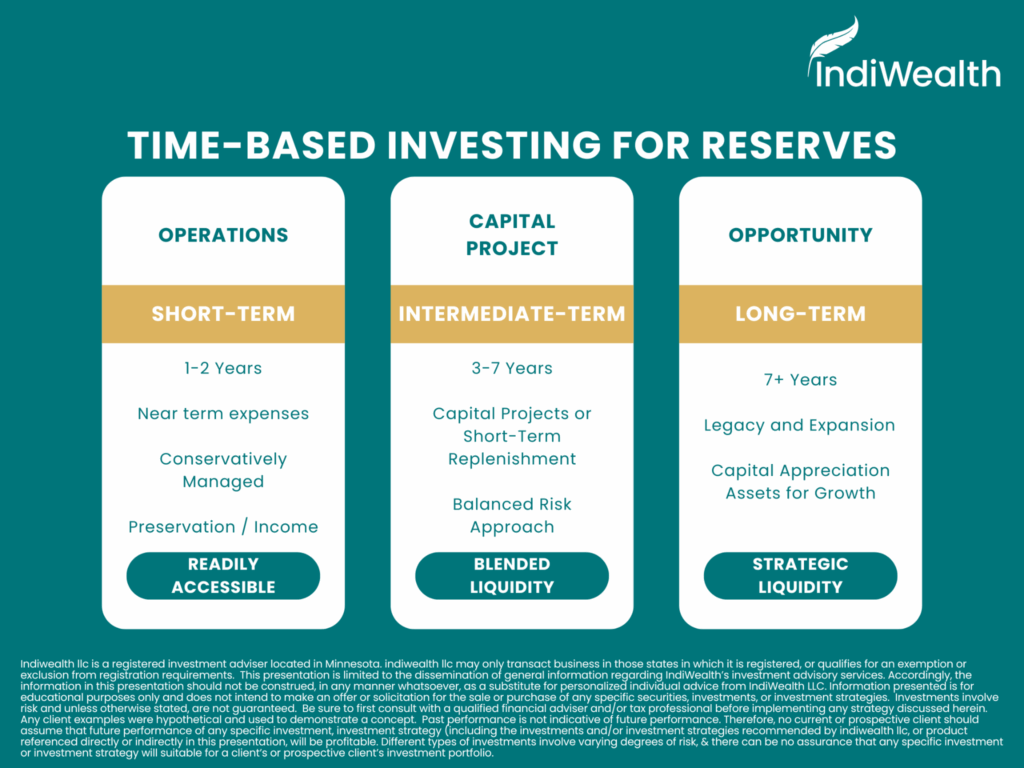
This week’s chart illustrates a time-based reserve strategy. By segmenting reserves according to when they might be needed, organizations can match each “tier” with an appropriate level of risk and return potential:
- Near-Term (1-2 years): High liquidity, cash equivalents, money markets, fixed income.
- Intermediate-Term (3-7 years): A balanced approach of income and growth assets.
- Long-Term (7+ years): Diversified investments with higher return potential (and greater risk).
Why This Matters
By stratifying reserves in this way, institutions can:
- Earn meaningful returns without sacrificing liquidity.
- Align investments with their true time horizon rather than defaulting to bank-only savings.
- Strengthen financial sustainability while preserving mission focus.
Additional Considerations
- Governance: Reserve investment strategies should be codified in a written investment policy statement approved by the board and reviewed periodically.
- Transparency: Regular investment reporting and review ensures leadership knows where reserves stand and adjusts for any changes in strategy.
- Compliance: Investments must remain consistent with nonprofit fiduciary standards.
If you’d like to learn more about structuring reserve investments, visit us at indiwealthmanagement.com.
Here’s the link to Propel Nonprofits’ full webinar: Nonprofit Reserves: What, Why, When, and How Much
This content, which contains security-related opinions and/or information, is provided for informational purposes only and should not be relied upon in any manner as professional advice, or an endorsement of any practices, products or services. There can be no guarantees or assurances that the views expressed here will be applicable for any particular facts or circumstances, and should not be relied upon in any manner. You should consult your own advisers as to legal, business, tax, and other related matters concerning any investment.
The commentary in this “post” (including any related blog, podcasts, videos, and social media) reflects the personal opinions, viewpoints, and analyses of IndiWealth employees providing such comments, and should not be regarded the views of IndiWealth LLC. or its respective affiliates or as a description of advisory services provided by IndiWealth or performance returns of any IndiWealth client.
References to any securities or digital assets, or performance data, are for illustrative purposes only and do not constitute an investment recommendation or offer to provide investment advisory services. Charts and graphs provided within are for informational purposes solely and should not be relied upon when making any investment decision. Past performance is not indicative of future results. The content speaks only as of the date indicated. Any projections, estimates, forecasts, targets, prospects, and/or opinions expressed in these materials are subject to change without notice and may differ or be contrary to opinions expressed by others.
Investments in securities involve the risk of loss.