

IndiView Chart of the Week: Shadow Banking
On October 16, the SPDR Regional Bank ETF (KRE) dropped 11.6% from its September 18 high as investors pulled more than $560 million from the $2.8 billion fund. The sell-off followed disclosures from two regional banks—Zions and Western Alliance—that alleged borrower fraud had led to unexpected loan losses.
Adding to investor anxiety were two recent bankruptcies: auto lender Tricolor and auto-parts supplier First Brands, which triggered losses at firms such as Jefferies, BlackRock, and JPMorgan Chase. On JPMorgan’s earnings call, CEO Jamie Dimon warned, “When you see one cockroach, there’s probably more.” His comment amplified fears not only around regional banks but also around institutions operating in the “shadow banking” ecosystem.
What Is Shadow Banking?
“Shadow banking” refers to financial intermediaries that extend credit outside the reach of traditional bank regulation. Examples include hedge funds, private-equity funds, mortgage lenders, and investment banks, as well as certain unregulated activities within large financial institutions, such as credit-default-swap trading.
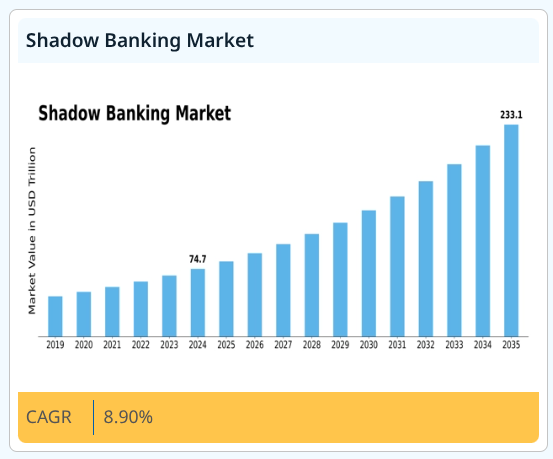
In this week’s chart, the shadow-banking market is projected to more than triple between 2024 and 2035—from roughly $74.7 billion to $233 billion—highlighting its growing role in global finance.
Why Demand Is Rising
Several forces are driving this expansion:
- Post-crisis regulation tightened lending standards for traditional banks, pushing borrowers toward non-bank lenders.
- Regulatory arbitrage allows shadow banks to operate with lower compliance costs, enabling them to offer loans at more competitive rates.
- FinTech innovation has made it easier for non-bank entities to underwrite and distribute loans.
- Investor appetite for yield has surged, with private-credit products offering higher returns and diversification relative to traditional bonds.
Implications
Dimon’s “cockroach” remark brought fresh attention to vulnerabilities across both regulated and non-regulated lenders. The boom in private-credit vehicles, which face lighter oversight, raises questions about how these institutions would fare if defaults rise. A wave of unrecognized losses could trigger a capital-liquidity squeeze, forcing shadow lenders to curtail operations—potentially straining the businesses that depend on them for financing.
While no broad contagion is evident yet, this segment remains a risk factor worth monitoring.
IndiOpinion
For now, we view this as a yellow flag, not a red one. Credit spreads have widened modestly but stabilized, and regional-bank declines appear to be moderating. There’s little evidence of stress in CLOs, bank-loan funds, or asset-backed securities.
Longer term, the durability of shadow lending will be tested. If defaults rise or regulation tightens, private-credit demand could slow, with ripple effects across capital markets. For now, however, we don’t see a cascading risk to the broader economy or equity markets.
We’ll continue to watch for signs of stress—but diversified exposure to credit assets still deserves a place in portfolios.
Chart Source: https://www.marketresearchfuture.com/reports/shadow-banking-market-23999
This content, which contains security-related opinions and/or information, is provided for informational purposes only and should not be relied upon in any manner as professional advice, or an endorsement of any practices, products or services. There can be no guarantees or assurances that the views expressed here will be applicable for any particular facts or circumstances, and should not be relied upon in any manner. You should consult your own advisers as to legal, business, tax, and other related matters concerning any investment.
The commentary in this “post” (including any related blog, podcasts, videos, and social media) reflects the personal opinions, viewpoints, and analyses of IndiWealth employees providing such comments, and should not be regarded the views of IndiWealth LLC. or its respective affiliates or as a description of advisory services provided by IndiWealth or performance returns of any IndiWealth client.
References to any securities or digital assets, or performance data, are for illustrative purposes only and do not constitute an investment recommendation or offer to provide investment advisory services. Charts and graphs provided within are for informational purposes solely and should not be relied upon when making any investment decision. Past performance is not indicative of future results. The content speaks only as of the date indicated. Any projections, estimates, forecasts, targets, prospects, and/or opinions expressed in these materials are subject to change without notice and may differ or be contrary to opinions expressed by others.
Investments in securities involve the risk of loss.