

Cool People, Good Work: Construction Careers Foundation
Let me start here: I think the U.S. higher education system is severely damaged, if not fully broken.
For decades it has operated on a simple model — federally supported lending allows schools to raise prices while students absorb the risk. The institution’s balance sheet stays protected while the graduate begins adulthood carrying debt that shapes every financial decision for years.
But the financial cost isn’t the only problem.
We have built an exclusionary culture around college admission. Students are pushed to “pad their stats,” optimize test scores, and spend formative years satisfying admissions criteria rather than discovering their interests. The system rewards signaling more than skill.
At the top end, elite universities increasingly resemble luxury brands. Like Mercedes or Rolex, scarcity is part of the value proposition. Capacity stays tight, prestige rises, and the brand itself becomes the product. Despite massive endowments, many of these institutions present themselves as ladders of opportunity when in practice they often function as gates preserving status.
I have two children approaching this crossroads. It used to be a no-brainer: go to college, work hard, meet people, and find your way. That path is still viable for many — but we’ve forgotten it isn’t the only path.
For a huge number of students, the traditional four-year degree is a high-risk gamble made before they understand the stakes. We’ve stigmatized those who don’t follow the academic route as if they’ve failed.
They haven’t. We’ve failed to show them real alternatives.
This month’s Cool People, Good Work highlights an organization working to fix exactly that: the Construction Careers Foundation (CCF).
CCF works directly with middle- and high-school students — bringing industry speakers into classrooms, organizing hands-on exposure to the trades, and connecting graduates to apprenticeships and employers across Minnesota. Their goal isn’t just awareness; it’s placement into real career pathways students can enter immediately after graduation. You can learn more about their programs at https://constructioncareers.org/
The Reality of the Physical Economy
CCF’s mission is straightforward — increase participation in the construction trades and connect students to long-term careers through partnerships with schools, educators, unions, and businesses across Minnesota.
At IndiWealth, we examine issues through data. Minnesota’s DEED Career Pathways tool allows us to filter occupations by education level and compare outcomes.
Source: https://mn.gov/deed/data/data-tools/career-pathways-tool/
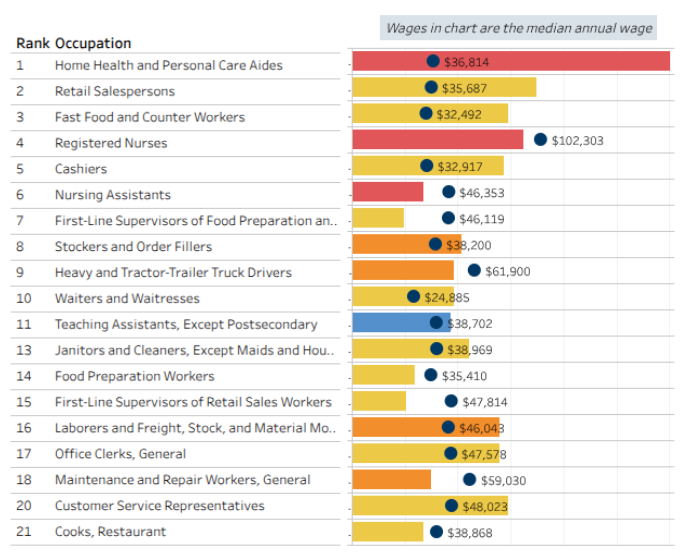
Looking only at jobs requiring an associate degree or less, the roles most people imagine — retail, food service, cashiering, general labor — cluster under roughly $40,000 median wages and several are projected to decline rather than grow in the years ahead.
Now compare that with architecture and construction occupations under the exact same education filter: Median wages for these jobs exceed $70,000 and nearly all roles show projected growth in the years ahead.
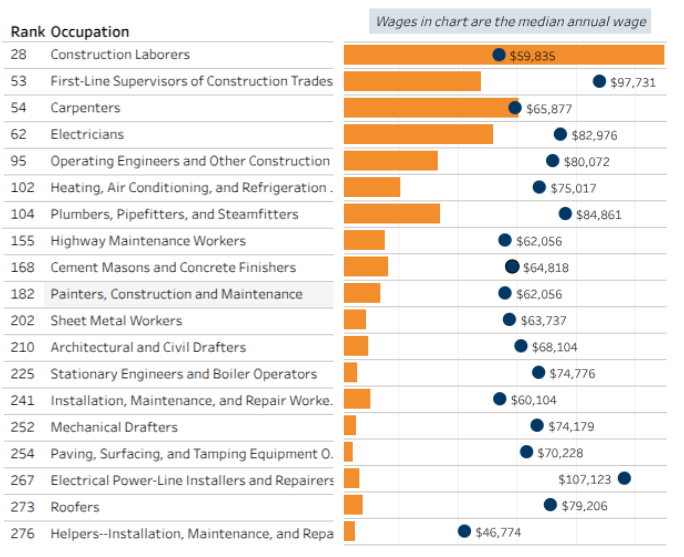
The difference isn’t college versus no college. It’s structured career pathways versus unstructured job-seeking — and most students are never shown that distinction early enough to matter.
Durability in an Automated Economy
There is another factor emerging quickly: displacement risk.
Artificial intelligence thrives in environments that are digital, repeatable, and rules-based — documentation, processing, and many entry-level knowledge roles. But physical problem solving remains opportunistically human.
AI can help design a building. It cannot install electrical wiring. It cannot repair a pipe in January.
Many skilled trades therefore possess something increasingly rare: economic durability — a degree of protection from automation that many traditional office-entry career paths may not have.
Why This Matters
Organizations like CCF are working to destigmatize trade careers as legitimate opportunities rather than fallback options.
When students understand they have multiple respected paths — university, apprenticeship, or technical training — they make better decisions and enter adulthood with direction instead of debt-driven pressure.
A healthier workforce isn’t created by pushing everyone through the same door. It’s created by helping people find the door that fits them.
We’re proud to support the Construction Careers Foundation and the work they’re doing to expand opportunity for the next generation — exactly what Cool People, Good Work is meant to highlight.
This content, which contains security-related opinions and/or information, is provided for informational purposes only and should not be relied upon in any manner as professional advice, or an endorsement of any practices, products or services. There can be no guarantees or assurances that the views expressed here will be applicable for any particular facts or circumstances, and should not be relied upon in any manner. You should consult your own advisers as to legal, business, tax, and other related matters concerning any investment.
The commentary in this “post” (including any related blog, podcasts, videos, and social media) reflects the personal opinions, viewpoints, and analyses of IndiWealth employees providing such comments, and should not be regarded the views of IndiWealth LLC. or its respective affiliates or as a description of advisory services provided by IndiWealth or performance returns of any IndiWealth client.
References to any securities or digital assets, or performance data, are for illustrative purposes only and do not constitute an investment recommendation or offer to provide investment advisory services. Charts and graphs provided within are for informational purposes solely and should not be relied upon when making any investment decision. Past performance is not indicative of future results. The content speaks only as of the date indicated. Any projections, estimates, forecasts, targets, prospects, and/or opinions expressed in these materials are subject to change without notice and may differ or be contrary to opinions expressed by others.
Investments in securities involve the risk of loss.