
IndiView Chart of the Week: AI Forces Adaptability
Experience has a way of turning new trends into familiar patterns. As you get “aged,” like I am, you start to make comparisons. While these comparisons aren’t always perfect, they provide a sense of “we’ve seen this movie before,” giving us a basis for how to respond to the next big shift.
I’ve been thinking about this regarding the deployment of Artificial Intelligence (AI). The concerns are obvious and very real: Will AI replace human activity? What happens to employment when computers do the work and make the decisions?
The “Implementation Gap”
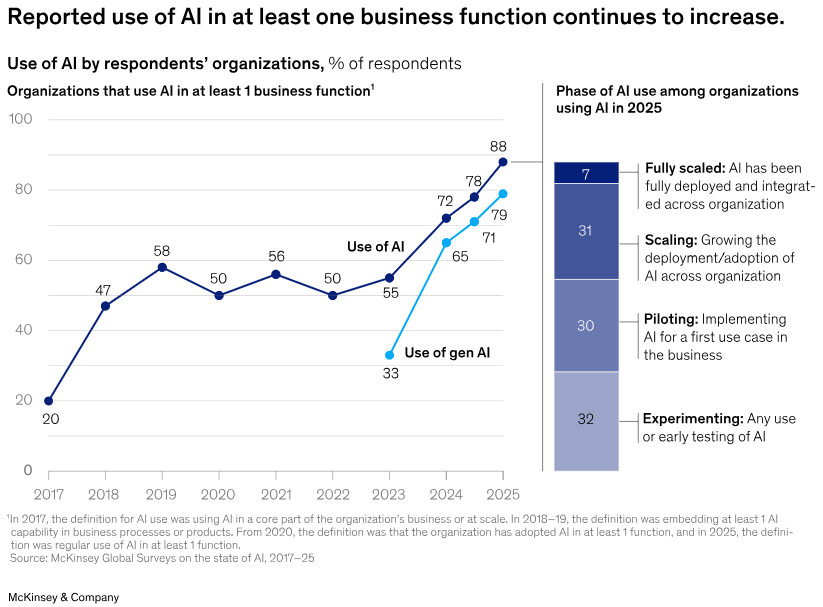
In today’s Chart of the Week from McKinsey and Company, we see that AI is officially mainstream—but it is far from “finished.”
The chart on the left shows usage by organization; on the right, the stage of deployment. Two things jump out:
- Broad Adoption: 88% of respondents say they use AI for at least one business function.
- The Pilot Phase: 62% of deployments are still in the experimentation or piloting phase.
This means we are still very early in the cycle. Businesses have the tools, but they are still figuring out the instruction manual.
My Thesis on the AI Shift
Now that we know deployment is here, here is how I believe the implications will shake out:
- Ubiquity: AI will touch nearly every aspect of enterprise business.
- The Small Business Edge: AI will make small businesses more competitive by allowing them to scale without the massive capital barriers of the past.
- Adaptability over Replacement: AI will eliminate specific tasks and “scripted” jobs, but it will create paths for adaptable employees to thrive.
- The Trust Premium: Customers still want to work with people they trust.
Software 1.0 helped us produce faster. AI is Software 2.0—it requires less “building” and more “deciding.” AI will build the output; we just need to analyze the results and make the call.
The “TurboTax” Lesson: Why CPAs Thrived
When I hear that AI will “kill jobs,” I think about CPAs. Accounting is a profession many thought would be destroyed by software.
TurboTax was introduced in 1984, allowing individuals to conduct complex tax analysis on their own. By that logic, CPAs should be extinct. However, in 1990, there were roughly 430,000 CPAs. By 2025, that number grew to 660,000—outpacing US population growth during the same period.
Why? Because software killed the low-level functions of the role, but the accountants adapted. They stopped being “form-fillers” and became “tax advisors.” They were freed up to make decisions regarding information rather than just compiling it.
Adapt or Die
This “adapt or die” mentality is now a universal requirement. AI will handle the processing and much of the creation. If you are a coder or a script-based call center representative, you shouldn’t be doubling down on the “script”—you should be figuring out how to add value to the result. The decision to be a horse-buggy manufacturer or a problem-solving accountant will be the defining choice for the next generation.
The Human Currency
My last thought is that trust is a uniquely human condition. People want to interact with other people when making high-stakes decisions about their lives.
In the investment business, there is a unique vocabulary and high degrees of specificity. But the most successful people in this industry aren’t necessarily those who calculate the fastest or memorize the most terminology—AI can do that. The winners are those who can relay complex concepts in a way that is relatable and trustworthy.
Knowledge can be enhanced by AI, but trust still has to be earned.
This content, which contains security-related opinions and/or information, is provided for informational purposes only and should not be relied upon in any manner as professional advice, or an endorsement of any practices, products or services. There can be no guarantees or assurances that the views expressed here will be applicable for any particular facts or circumstances, and should not be relied upon in any manner. You should consult your own advisers as to legal, business, tax, and other related matters concerning any investment.
The commentary in this “post” (including any related blog, podcasts, videos, and social media) reflects the personal opinions, viewpoints, and analyses of IndiWealth employees providing such comments, and should not be regarded the views of IndiWealth LLC. or its respective affiliates or as a description of advisory services provided by IndiWealth or performance returns of any IndiWealth client.
References to any securities or digital assets, or performance data, are for illustrative purposes only and do not constitute an investment recommendation or offer to provide investment advisory services. Charts and graphs provided within are for informational purposes solely and should not be relied upon when making any investment decision. Past performance is not indicative of future results. The content speaks only as of the date indicated. Any projections, estimates, forecasts, targets, prospects, and/or opinions expressed in these materials are subject to change without notice and may differ or be contrary to opinions expressed by others.
Investments in securities involve the risk of loss.